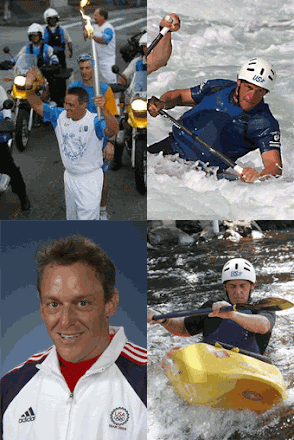
Tune into any of the 24 hour news networks and given the state the state of the economy, you’d think people are not going anywhere this summer, not doing anything fun, or not learning something new. Here at the Ocoee River in Tennessee, the recent surge of visitors on and off the water suggests an evolving trend – people are in fact prioritizing the idea of getting out of town and putting themselves in different surroundings. In other words, they’re seeking live.
The compelling difference right now compared to past years is the advanced planning that goes into such travel – virtually none at all. Getting away is becoming “last-minute” in nature and people are simply showing up at the front door at our raft company and kayak school unannounced ready for adventure. Jackson Kayaks Founder and President, Eric Jackson, suggested as much in a recent interview saying, “Even in these times, Americans don’t want to compromise on lifestyle.”
The upside of a down economy is that people re-adjust and look for improved solutions. They change past patterns that haven’t produced good results. They stretch themselves into trying new and better things. And they find creative and effective ways to grow, learn, and do better.
These attributes parallel some of the fundamental skills and benefits of navigating rapids on the river and there’s much more to be learned on whitewater that translates to our lives away from the river. Maybe that’s why the river is a good match for the way people want to spend time away from home at the moment. To that end, similar as how we approach the current world and challenges around us, kayaks and rafts are always doing one of two things on the river – working with it or fighting against it. Which one are you doing?
Showing posts with label Ocoee. Show all posts
Showing posts with label Ocoee. Show all posts
Monday, June 2, 2008

Saturday, April 19, 2008
Kayaking on TV
One of the best parts of the Olympic season for canoeing and kayaking is the media attention on the sport. Of course our hope is that more people will want to try kayaking as a result of having seen the sport and how easy it is to learn.
Oklahoma City's KFOR Channel 4 correspondent Ali Meyer supports our efforts and joined me for short kayak lesson on the Oklahoma River just before the start of the Flatwater Olympic Trials. Check out the story at:
http://www.kfor.com/global/video/popup/pop_player.asp?ClipID1=2400341&h1=Learning%20how%20to%20Kayak%20with%20Ali%20Meyer&vt1=v&at1=Community&d1=181766&LaunchPageAdTag=Search
Oklahoma City's KFOR Channel 4 correspondent Ali Meyer supports our efforts and joined me for short kayak lesson on the Oklahoma River just before the start of the Flatwater Olympic Trials. Check out the story at:
http://www.kfor.com/global/video/popup/pop_player.asp?ClipID1=2400341&h1=Learning%20how%20to%20Kayak%20with%20Ali%20Meyer&vt1=v&at1=Community&d1=181766&LaunchPageAdTag=Search
Saturday, March 8, 2008
Beyond Judgment and Perspective
Kayaking is a sport that is naturally associated with risk. In fact, for many, accessing and taking risk is a part of the sport’s appeal. To me, the opportunities and challenges associated with kayaking are far more about judgment and perspective than they are about risk. This is as true when I’m driving a car or walking in a city as it is about paddling on rivers 200 days each year.
One of the truly great people with whom I shared the river is a major contributor to my own judgment and perspective on the river and the larger society around us. John Mullen, who tragically lost his life on the river in 2005, is the subject of a touching article written by his brother, Kurt, in the latest issue of Paddler Magazine:
http://www.paddlermagazine.com/issues/2008-2/article_319.shtml
My family and I came to know John, a writer and editor for the Washington Post, when he traveled to the Ocoee River in 2002 to cover my training for the Olympic Games in Athens. John was an aspiring and enthusiastic whitewater kayaker himself at the time but while in Ducktown, he wanted to “live and learn” my daily pursuits as an Olympic hopeful. While living in our home with us for four days, he paddled, ran, lifted weights, and mountain biked with me never missing a workout or an opportunity to engage further into the subject at hand. He just naturally “fit in” with the people with whom he wrote about and valued them, often better than they valued themselves. The great “students of life” seem to have a unique way of doing this.
John was much more than a great writer although his “Outside Line” columns every Sunday were among the best written pieces in a top-flight newspaper. His passion for living and willingness to keep asking himself, “can I do better?” became the fuel that brought him to the 2004 Whitewater Olympic Trials in South Bend, Indiana – not as a journalist covering the race but as a competitor racing in the event.
It’s been said that great writers often possess great conflict. In my opinion, here was John’s - in a world where so many are living a pursuit of “understanding” themselves and the world around them, John understood others and their world around them in a deep, personal, connective, and profound manner much better than he understood himself.
The ironic part of this is that while his path of self exploration may not have resolved all of his own questions, his process of getting there brought purposeful clarity to many others in his circle. And coming up on three years since losing John, not only is the spirit of John’s pursuits alive and well, I believe his circle of influence upon others is growing and stronger than ever.
Thank you, Kurt, for the great article and reminding us of the good for which John stood – John would be proud.
One of the truly great people with whom I shared the river is a major contributor to my own judgment and perspective on the river and the larger society around us. John Mullen, who tragically lost his life on the river in 2005, is the subject of a touching article written by his brother, Kurt, in the latest issue of Paddler Magazine:
http://www.paddlermagazine.com/issues/2008-2/article_319.shtml
My family and I came to know John, a writer and editor for the Washington Post, when he traveled to the Ocoee River in 2002 to cover my training for the Olympic Games in Athens. John was an aspiring and enthusiastic whitewater kayaker himself at the time but while in Ducktown, he wanted to “live and learn” my daily pursuits as an Olympic hopeful. While living in our home with us for four days, he paddled, ran, lifted weights, and mountain biked with me never missing a workout or an opportunity to engage further into the subject at hand. He just naturally “fit in” with the people with whom he wrote about and valued them, often better than they valued themselves. The great “students of life” seem to have a unique way of doing this.
John was much more than a great writer although his “Outside Line” columns every Sunday were among the best written pieces in a top-flight newspaper. His passion for living and willingness to keep asking himself, “can I do better?” became the fuel that brought him to the 2004 Whitewater Olympic Trials in South Bend, Indiana – not as a journalist covering the race but as a competitor racing in the event.
It’s been said that great writers often possess great conflict. In my opinion, here was John’s - in a world where so many are living a pursuit of “understanding” themselves and the world around them, John understood others and their world around them in a deep, personal, connective, and profound manner much better than he understood himself.
The ironic part of this is that while his path of self exploration may not have resolved all of his own questions, his process of getting there brought purposeful clarity to many others in his circle. And coming up on three years since losing John, not only is the spirit of John’s pursuits alive and well, I believe his circle of influence upon others is growing and stronger than ever.
Thank you, Kurt, for the great article and reminding us of the good for which John stood – John would be proud.
Tuesday, March 4, 2008
An Experience Worth Repeating
Ask a few kayakers what they enjoy about their sport and you’re sure to hear more than a few times, “Getting away it from all.” Certainly compared to the busy work-driven lives of many, rivers can deliver on removing you from the masses and bringing you solitude. Here in southeastern Tennessee, that experience is a little different. Sure we have a great river running through the heart of a National Forest and the nearest town is small even by small-town standards with just two traffic lights and a few stop signs. Removed it is, but a wide open river it isn’t.
Within a three and half hour drive of more than 20 million people, the Ocoee River is one of the primary centers of whitewater culture and rarely a place you’ll find yourself alone on the river. My river friends in Chicago routinely drive 20 plus hours roundtrip for a weekend on the Ocoee and that’s not as uncommon as you might think. And in addition to the many kayakers, you’re paddling among rafters too. Not just a few rafters either, lots of them – more than 300,000 last year.
So I started thinking about it, “Why do paddlers keep coming back to the Ocoee?” After all, more remote rivers are flowing not too far away and for that matter, other activities and people are competing for your time, attention, and resources.
For kayakers, as much as people like getting away from it all, paddlers enjoy sharing their river pursuits with other like-minded paddlers. It is an intensely personal sport but one that’s very easy to share with friends on the river, particularly one that attracts so many different styles of paddlers from so many different places. The Ocoee is a special river that does cut across those lines.
But after living here for 15 years, I’ve observed something else too. If the Ocoee was a river where people just enjoyed the activity of kayaking, then the numbers of paddlers would have dried up years ago. After all, the rapids, rocks, and water flow on this river remain unchanged. But, more people kayaked this river last year than ever before and many of them were the same people I see paddling this river every year. Why? In a sport that loves its unpredictability and not exactly knowing what’s around the next bend, there’s something pleasant about something familiar – whether it’s the river itself or another a paddler you’ve been seeing on the same river for many years.
It’s a powerful perspective on change – not necessarily change in the sport, equipment, or the river but how a lifestyle pursuit becomes the lens for how we see the changing world around us.
Within a three and half hour drive of more than 20 million people, the Ocoee River is one of the primary centers of whitewater culture and rarely a place you’ll find yourself alone on the river. My river friends in Chicago routinely drive 20 plus hours roundtrip for a weekend on the Ocoee and that’s not as uncommon as you might think. And in addition to the many kayakers, you’re paddling among rafters too. Not just a few rafters either, lots of them – more than 300,000 last year.
So I started thinking about it, “Why do paddlers keep coming back to the Ocoee?” After all, more remote rivers are flowing not too far away and for that matter, other activities and people are competing for your time, attention, and resources.
For kayakers, as much as people like getting away from it all, paddlers enjoy sharing their river pursuits with other like-minded paddlers. It is an intensely personal sport but one that’s very easy to share with friends on the river, particularly one that attracts so many different styles of paddlers from so many different places. The Ocoee is a special river that does cut across those lines.
But after living here for 15 years, I’ve observed something else too. If the Ocoee was a river where people just enjoyed the activity of kayaking, then the numbers of paddlers would have dried up years ago. After all, the rapids, rocks, and water flow on this river remain unchanged. But, more people kayaked this river last year than ever before and many of them were the same people I see paddling this river every year. Why? In a sport that loves its unpredictability and not exactly knowing what’s around the next bend, there’s something pleasant about something familiar – whether it’s the river itself or another a paddler you’ve been seeing on the same river for many years.
It’s a powerful perspective on change – not necessarily change in the sport, equipment, or the river but how a lifestyle pursuit becomes the lens for how we see the changing world around us.
Sunday, March 2, 2008
Dancing vs Fighting
Whitewater kayakers learn and re-learn this lesson every time they head to the water – if you’re not working with the river, you’re working against it. No matter how proficient you are paddling through rapids, one fundamental rule of whitewater kayaking never changes – you’re never stronger than the river.
Life mirrors the river too in that the field on which we play also has energy to give and take – and in navigating its challenges, we either dance with that energy or fight against it.
In the world of politics, when candidates shout at me how much they will “fight” to win, the red flags go up. In the world of business, when CEOs use analogies of war, I tune out. In the world of sports, when coaches speak about the struggles of achieving success, I instantly wonder if there isn’t a better way.
For seven consecutive years, bicycle racing television commentator, Phil Liggett, has often used the phrase, “Dancing on the Pedals” when describing the way Lance Armstrong “glided” UP the sides of French mountains the way most of us could hope to “glide” down. Sure, there’s an output of serious work there but before that, there’s taking whatever you can get out the mountain first. Surfers use the same principle with the wave, mountain bikers with the trail, and kayakers with the river.
Of course there’s going to be challenge on the road to living better and perseverance plays a big part in overcoming obstacles. But knowing yourself and the field on which you’re playing are key “game-changing” dynamics throughout the journey of getting there.
As kayakers know, there’s plenty of energy out on the river and most of them will tell you, “It’s never too late to dance.”
Life mirrors the river too in that the field on which we play also has energy to give and take – and in navigating its challenges, we either dance with that energy or fight against it.
In the world of politics, when candidates shout at me how much they will “fight” to win, the red flags go up. In the world of business, when CEOs use analogies of war, I tune out. In the world of sports, when coaches speak about the struggles of achieving success, I instantly wonder if there isn’t a better way.
For seven consecutive years, bicycle racing television commentator, Phil Liggett, has often used the phrase, “Dancing on the Pedals” when describing the way Lance Armstrong “glided” UP the sides of French mountains the way most of us could hope to “glide” down. Sure, there’s an output of serious work there but before that, there’s taking whatever you can get out the mountain first. Surfers use the same principle with the wave, mountain bikers with the trail, and kayakers with the river.
Of course there’s going to be challenge on the road to living better and perseverance plays a big part in overcoming obstacles. But knowing yourself and the field on which you’re playing are key “game-changing” dynamics throughout the journey of getting there.
As kayakers know, there’s plenty of energy out on the river and most of them will tell you, “It’s never too late to dance.”
Saturday, March 1, 2008
Escaping What?
In starting a blog, I started to read a lot more blogs. It’s astonishing how many posts there are about escaping your job, your office, your company, your cubicle, your co-workers, your commute, your home, your neighbors, your friends, and even your family. In other words, “escaping” your life.
As someone living the outdoor/adventure lifestyle, this strikes me as fairly drastic thinking. Sure we want to do better in all facets of our lives, raise standards, be happier and more enlightened. But what is realistic and most likely to put us on such a road?
Too often I see people trade out their current lives to “start over” again here in the mountains. Drawn by the appeal of anything that is the antithesis of their current existence, a new home, a new culture, and a new environment make for a huge change. But too often, it doesn’t work out so well. It was too much change too quickly and people were never well situated to gain a decent "outside looking in" perspective of themselves and successfully evaluate such a change in the first place. They never quite knew or understood what it was that they were escaping.
Over the years, the happiest people I’ve seen (and continue to see) on the trails and rivers seem to achieve great balance in their lives with a deep understanding of how the activities they love doing integrate into their “bigger picture.” In other words, they are intentional about what they “live for” as opposed to what they are “escaping from.”
I enjoy encouraging and supporting friends to follow paths toward happier pursuits. I’d be the first to admit that changing “realities” is one exciting journey. But on such an important journey, getting the “big result” requires a lot of bite-sized change. “Wholesale Change” thinking is powerful, but implementing small, attainable, and tangible goals into your current lifestyle starts moving you in a better direction.
As someone living the outdoor/adventure lifestyle, this strikes me as fairly drastic thinking. Sure we want to do better in all facets of our lives, raise standards, be happier and more enlightened. But what is realistic and most likely to put us on such a road?
Too often I see people trade out their current lives to “start over” again here in the mountains. Drawn by the appeal of anything that is the antithesis of their current existence, a new home, a new culture, and a new environment make for a huge change. But too often, it doesn’t work out so well. It was too much change too quickly and people were never well situated to gain a decent "outside looking in" perspective of themselves and successfully evaluate such a change in the first place. They never quite knew or understood what it was that they were escaping.
Over the years, the happiest people I’ve seen (and continue to see) on the trails and rivers seem to achieve great balance in their lives with a deep understanding of how the activities they love doing integrate into their “bigger picture.” In other words, they are intentional about what they “live for” as opposed to what they are “escaping from.”
I enjoy encouraging and supporting friends to follow paths toward happier pursuits. I’d be the first to admit that changing “realities” is one exciting journey. But on such an important journey, getting the “big result” requires a lot of bite-sized change. “Wholesale Change” thinking is powerful, but implementing small, attainable, and tangible goals into your current lifestyle starts moving you in a better direction.
Subscribe to:
Posts (Atom)