Sunday, April 27, 2008

Quick Update from Trials....


After an intense first two days of racing here at the Olympic Trials at the U.S. National Whitewater Center, all categories are up for grabs heading into the third and final day. A few things we do know:

- By virtue of good results on Saturday, the U.S. will field a full whitewater team at the Olympic Games in Beijing.

- The event has turned out large crowds each day - estimated Saturday crowd was 5,000 spectators.

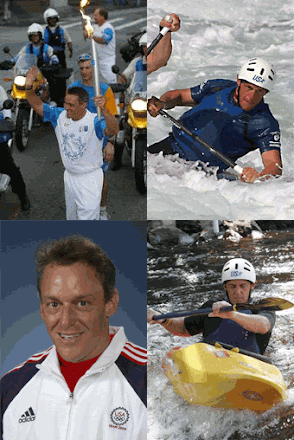
- As the photo suggests, EJ is having a lot of fun.

Full results are available at:

http://animastiming.com/2008-olympic-slalom-results

Stay tuned....

Thursday, April 24, 2008

Scott and Brett

As the Olympic Whitewater Trials gets ready to start tomorrow here in Charlotte, much of the athlete media coverage has focused upon men’s kayak frontrunners, Scott Parsons and Brett Heyl. Both were my Olympic teammates during my final Olympic Games four years ago in Athens and I came to know them both in a different light on and off the water.

The test of friendship and competition is the featured element of recent stories on NPR and in the Washington Post. But for me, a fascinating part of their pursuits is how vastly different two competitors can structure such different athletic quests for our one Olympic spot and come out so close in the end. It’s the essence of marching to the beat of your own drum yet kindly acknowledging that your beat might not work for everyone else.

Scott brings an introverted, grounded, and powerful resolve to his paddling. Brett is an extrovert who draws incredible energy from engaging people of all kinds into the sport of kayaking. One’s source of energy wouldn’t work well for the other and vice versa. Ultimately, it’s not so much which way is the right way but believing in your own way to achieve excellence in kayaking at this level. There’s no problem there – all systems are ready to go.

Spending time with both Scott and Brett this week during on-river practice sessions, I can only simplify their racing and values like this – their representations of themselves and outreach to each other have not only been first-class but their pursuits have honored kayaking and the Olympic Movement at their respective cores in a way that anyone would be proud.

Tuesday, April 22, 2008

Eric Jackson's Chattanooga Olympic Zone Profile

Back home in Tennessee, I'm fortunate to work with WRCB TV, the NBC affiliate in Chattanooga. I host the "Chattanooga Olympic Zone" in which we profile Chattanooga-related Olympic stories for the evening news broadcast. Since my 1992 Olympic teammate, Eric Jackson, is competing here in Charlotte and houses his fabulous kayaking manufacturing company, Jackson Kayaks, just up the road in Sparta, we figured Eric was an obvious choice for our feature segment. Working in television shouldn't be this much fun and I couldn't be more thrilled that Eric and his daughter Emily will be competing here in Charlotte at the Olympic Trials. Click the link below to see Eric's Chattanooga Olympic Zone profile:

http://www.wrcbtv.com/global/video/popup/pop_player.asp?ClipID1=2409907&h1=The%20Olympic%20Zone%3A%20E.J.%20Sparta&vt1=v&at1=News&d1=183900&LaunchPageAdTag=Olympics&activePane=info&playerVersion=1&hostPageUrl=http%3A//www.wrcbtv.com/Global/story.asp%3FS%3D8210608&rnd=84621745

The Big Mirror

This being the first Olympic Trials of the previous four in which I am not competing, I’ve been wondering what it is about these Olympic Trials that would appeal to spectators, internet users, or viewers of the MSNBC broadcast coming next month. Of course there’s the pure nature of a race, particularly a race of the magnitude where Olympic dreams either continue on or come to a close. There’s also the natural attraction to whitewater and the venue hosting this event, the U.S. National Whitewater Center.

But watching from the side of the river as opposed to being in it, I’ve come to see the Olympic Trials as that of a reflection of ourselves and our own lives. How do we identify with athletes and their competitive values? How do their athletic characteristics parallel our own life pursuits?

Watching a paddler like Benn Fraker gets you thinking about such things. More than any other single athlete in our program, Benn does not blink an eye at taking on challenges that are beyond him. Whether it’s the difficulty of his practice courses or the level of competitor he is chasing, his bar is set at the top. It is people like Benn who take on such challenges that put themselves in uncomfortable situations every day. They also know it is a special path to raising standards and performing better.

Maybe it has been a while since you’ve evaluated how effectively you throw yourself into your own “beyond reach” situations but watching Benn paddle makes you think about it. He and roughly 130 other athletes will be testing their competitive style here in Charlotte this weekend – against the river, themselves, and each other. For those of us watching, it’s like standing in front of a big mirror. Which reflection will you see?

Monday, April 21, 2008

The Source of a River

It’s not uncommon for kayakers to ponder about the source of the river they’re paddling on a given day. Such thinking contributes to the humility and appreciation of an activity like kayaking. Here at the U.S. National Whitewater Center in Charlotte, North Carolina, site of this year’s U.S. Olympic Trials for Whitewater Slalom, the venue is more of a symbol of where the sport is heading more than where it’s been. Having said that, the concept of powerful whitewater rapids in Charlotte where a river never existed before is increasingly becoming a more important part of kayaking’s evolving history.

Back in 2000, two visionaries from Charlotte, Vic Howie and Chet Rabon, attended the Olympic Whitewater Trials on Tennessee’s Ocoee River, site of the 1996 Olympic Whitewater events. Watching the competition on this modified natural river, Vic and Chet kept asking themselves, “Why can’t we do this in Charlotte?” Back in my living room that evening, a bottle of wine, a drawing on a cocktail napkin, and some spirited conversation and brainstorming lifted the concept of the “Charlotte Whitewater Park” up off the ground.

Of course it went further than that. Upon returning to Charlotte, they knocked on doors, introduced themselves and their idea, and shared their vision with anyone who would listen – they knew that openly and honestly engaging people and building alliances would be the only way to gain the public trust needed to complete such a project in Charlotte.

Much has transpired over the past eight years but one of Vic and Chet’s major milestones is about to happen this weekend. The Olympic Trials will be contested here in Charlotte on this venue – a venue that was conceived at one of the great American institutions of sport for “dreaming big,” the Olympic Trials. So with that, U.S. Whitewater athletes take their next step towards Beijing this weekend. And if any of the paddlers here stop for a moment to acknowledge the source of this river, they won’t have to wonder where the source starts – they can just hop out of their boats, shake hands with them and say thanks. I know I will.

Thank you, Oklahoma City

The racing between the start and finish lines at the Flatwater Olympic Trials this past weekend could have taken place just about anywhere and a good, capable group of athletes would have taken a step closer to paddling at the Olympic Games this summer in Beijing. But for the elements that make a canoe/kayak event special, memorable and world-class, Oklahoma City and its Chesapeake Boathouse set a new benchmark for paddlesports and on a personal note, I just wanted to say thank you to the amazing people who made the Olympic Trials in Oklahoma City a reality.

Organizers, volunteers, coaches, athletes, media, and sponsors worked together seamlessly and the result went far beyond fabulous kayak racing. The inclusion and influence of paddlesports on the way Oklahoma City lives, works, and plays by far exceeds the impact of what I thought was possible in a city of this size.

As I turn my attention to Whitewater Olympic Trials this week in Charlotte, thank you Oklahoma City for sharing your community’s spirit with us – the sport is already better for it.

Saturday, April 19, 2008

Resolving to Resolve Later

Selecting a kayaker to represent the U.S. at the Olympic Games is not a straightforward process. One USA Canoe/Kayak official told me today that their Olympic Team selection criteria is more than 30 type-written pages, which only appears a little strange to a spectator when you see how straightforward flatwater kayaking is. The mano-a-mano, first-to-the-finish nature of the race is pure, rich, and the dominant intensity factor in this beautiful sport. And no race demonstrated this essence on Friday more than the men’s 500 meter single kayak (K1) race.

With a win in this event, two-time Olympian, Rami Zur, would qualify directly to his third Olympic Games this summer in Beijing. Confident, strong, and always looking for a big challenge, I got to know Rami five years ago during a “team-building” outing hosted by the U.S. Olympic Committee (USOC) for Athens Olympic hopefuls. Our group of about 100 athletes went to the Naval Special Warfare Center in San Diego where we would tackle the training/obstacle course used to train and prepare Navy Seals. As our bus pulled closer to the obstacle course, our eyes fixated on a 55-foot wooden frame of ropes dropping out of the sky. I nervously said, “Climbing harnesses to go over those, don’t you think?” To which Rami replied, “No way, my friend.”

As we filed off the bus, the USOC officials, who had not seen the obstacle course in person before this moment, were quickly dissuading athletes from climbing the wall of ropes. But it was too late. Athletes were sprinting towards the wall like kids running to an ice cream truck on a summer afternoon. Leading the pack and smiling ear to ear was Rami. He scaled up the wall like Spiderman, hurled himself over the huge cross-log at the top, and flew down the other side giggling while the most of the other athletes were still sizing up the challenge from the ground on the other side.

It is this kind of can-do spirit that defines an athlete who would likely take the men’s 500 meter K1 Olympic slot on the U.S. Olympic Team. However, that spirit was provided by someone else on Friday.

Morgan House of Gainesville, GA played the role of “challenger” in this event. At 20 years-old, Morgan’s racing conveys wisdom beyond his years and a competitive fire that burns from “inside.” Calm, cool, and confident, Morgan brings something new to the race which is what made his strong surge in the last 100 meters to win here at the Olympic Trials much more interesting. Between Morgan and Rami, we’re treated to two very different styles trying to win the same race.

Which leads us to our un-resolution of this Olympic spot here at the Olympic Trials. By virtue of winning on Friday, Morgan doesn’t take the Olympic spot but he does prolong the Olympic selection until early June when he and Rami will compete in Europe for the start position in Beijing. It’s a “winner take all” situation and over the next six weeks, the emotion of two very different kayakers raising their standards, pushing harder, and going faster will be exciting to watch. But take away the emotion from that process and one element strikingly stands out. The U.S. will field a better kayak racer in Beijing by resolving to resolve later.